
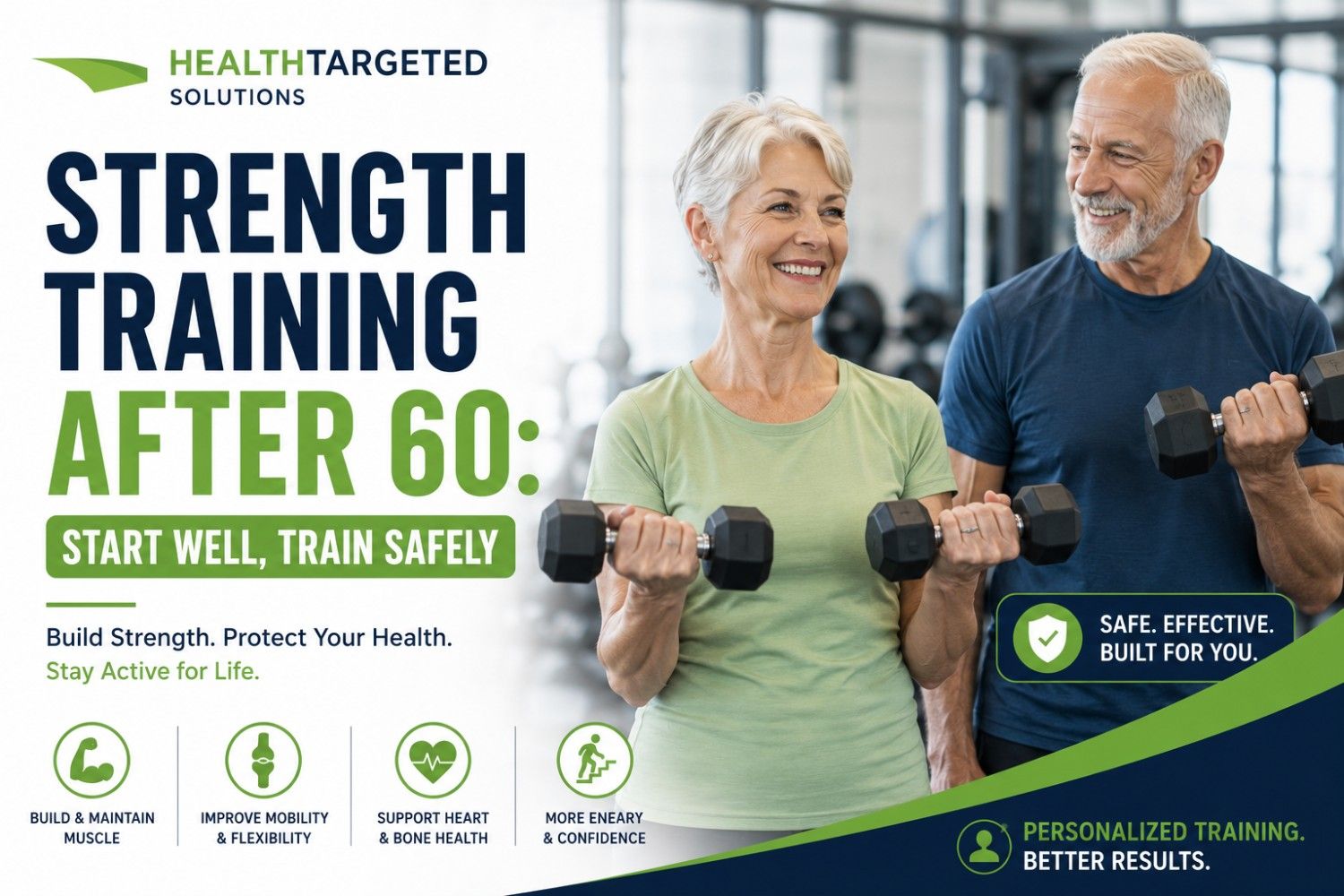
Strength training after 60 is one of the most effective interventions available for preventing falls, preserving functional independence, slowing cognitive decline, and maintaining quality of life through the decade ahead. Adults in their 60s can build meaningful muscle and strength with well-designed resistance training, regardless of their starting point.
Key Insights
Strength training after 60: why it matters, and how to start safely.
Expand key insights
- Strength training after 60 is one of the most effective interventions for preventing falls, preserving independence, and slowing cognitive decline, not just a fitness choice.
- CDC data shows 1 in 4 adults 65 and older falls every year, and falls are the leading cause of injury-related death in this age group. The muscle strength and balance that prevent falls are built through resistance training.
- Age-related muscle loss (sarcopenia) accelerates after 60, roughly doubling from the 3 to 5 percent per decade lost in your 30s through 50s. Resistance training is the primary evidence-based way to slow or reverse it.
- Roughly 10 million Americans have osteoporosis, about 80 percent of them women. Weight-bearing resistance training slows bone density loss at any age, including your 60s.
- Bodyweight training is a legitimate starting point at 60, not a lesser version of "real" training. Sessions can be shorter, but warm-up and cool-down both become non-negotiable.
- Physician clearance is more strongly recommended at 60 than at younger ages, especially for adults managing cardiovascular conditions, osteoporosis, or joint issues.
Table of Contents
The question most people ask about strength training after 60 is whether it is too late to start. That question misses the more important one.
The better question is what happens to the body over the next ten years with strength training versus without it. The answer to that question is what makes starting, or continuing, one of the most consequential health decisions available in this decade.
Adults in their 60s who strength train consistently are less likely to fall. They maintain the functional strength to live independently. Research links regular resistance training in older adults to reduced cognitive decline risk. They recover from illness and surgery faster. The benefits at this age extend well beyond appearance or body composition.
This post covers what changes in the 60s, how to structure training safely, where to start as a beginner, and what to expect.
Why Strength Training Matters More in Your 60s, Not Less
Each decade from the 30s onward brings gradual muscle loss. In the 60s, several factors converge to make this loss more consequential.
Sarcopenia becomes clinically significant
Sarcopenia is the term for age-related muscle loss that reaches a level affecting physical function. While muscle loss is gradual from the 30s onward, the 60s are where it crosses from a background process into something that noticeably affects strength, walking speed, balance, and the ability to perform daily tasks. Resistance training is the primary evidence-based intervention for reversing sarcopenia.
Source: Harvard Health; Cleveland Clinic. Individual rates vary by activity level.
Fall risk increases substantially
Falls are the leading cause of injury-related death among adults over 65 in the United States. A hip fracture in this age group carries serious consequences, with a significant portion of older adults who sustain hip fractures not returning to their previous level of function. The muscle strength, balance, and proprioception that prevent falls are built through resistance training. They are not maintained through inactivity.
Bone density loss continues
For women who went through menopause in their 50s, the steepest phase of post-menopausal bone density loss has passed. But bone density does not recover on its own. Osteoporosis, the clinical level of bone density loss, affects approximately 10 million Americans, with women representing the large majority of cases. Weight-bearing resistance training slows ongoing bone density loss at any age, including the 60s.
Cognitive health
Research has found an association between regular resistance training and reduced risk of cognitive decline in older adults. The mechanism is not fully understood, but the relationship between strength training, blood flow, brain-derived neurotrophic factor production, and cognitive function has appeared consistently enough in the research to be worth noting. For adults in their 60s with family history of cognitive decline, this benefit carries real weight.
Cardiovascular and metabolic health
The cardiovascular risk factors that accumulate with age, including blood pressure, blood sugar regulation, and lipid profiles, respond positively to resistance training. For adults in their 60s managing hypertension, type 2 diabetes, or elevated cardiovascular risk, strength training is not just fitness. It is part of the clinical picture.
For Women Over 60
Women in their 60s are typically five to fifteen years past menopause. The most significant risks are now accumulated rather than accelerating: bone density has declined, muscle mass is lower than it was a decade ago, and the fall-and-fracture risk that seemed theoretical at 50 is measurable at 65.
The case for strength training for women over 60 is built on three concrete outcomes.
Maintaining functional independence
The physical capacity to dress yourself, get up from a low chair without using your arms, carry bags, climb stairs, and get up off the floor if you fall is determined largely by lower body and core strength. These capacities decline predictably without resistance training and can be maintained and improved with it.
Reducing fall and fracture risk
Stronger legs, better balance, and improved proprioception directly translate to fewer falls. Exercises that challenge single-leg stability, that require the body to react and stabilize, and that build hip and knee strength are the most direct interventions for fall prevention. They should be in every program for women over 60.
Supporting bone health in the presence of osteoporosis
Women over 60 with osteoporosis require specific exercise selection. High-impact loading, extreme spinal flexion, and certain twisting movements under load carry fracture risk and should be avoided or modified. A trainer who understands the exercise contraindications for osteoporosis is not optional for this population. It is the difference between a program that helps and one that harms. Health Targeted Solutions works with clients managing osteoporosis and programs accordingly.
For Men Over 60
Men in their 60s face a hormonal environment that has been changing for thirty years. Testosterone levels that were declining gradually since the 30s are now significantly lower. The effects on muscle mass, recovery, energy, mood, and cognitive function are tangible at this stage.
Men over 60 who have not previously strength trained will see meaningful results from starting now. The body's capacity to adapt to resistance training does not close at 60. What changes is the timeline for those adaptations, the recovery required between sessions, and the importance of programming that accounts for the health conditions that are more common in this decade.
Men over 60 with cardiovascular disease, a history of cardiac events, uncontrolled hypertension, or significant joint conditions should discuss the design of a training program with their physician before starting. This is not a barrier to training. It is how you train safely and effectively in the presence of real health complexity.
The cognitive benefits of resistance training noted above are relevant for men as well. The relationship between strength training, hormonal health, and cognitive function in older men is an active area of research. The practical implication is that strength training at this age produces benefits that extend beyond the gym.
Not Sure Where to Start?
A free intro session is a conversation and movement assessment built around your health history and current fitness level. No workout, no commitment.
Book Your Free Intro SessionHow Training After 60 Differs From Your 50s
Read our guide to strength training after 50 for the foundational framework. What follows are the specific modifications that the 60s require.
Start with physician clearance
More strongly recommended at 60 than at 40 or 50. Multiple health conditions are more common in this decade, and some conditions (uncontrolled hypertension, recent cardiac events, certain bone conditions) require specific programming adjustments or medical supervision. A conversation with your doctor before starting is not excessive caution. It is appropriate.
Bodyweight is a genuine starting point
At 40 and 50, the recommendation is to start with moderate loads and progress. At 60, bodyweight training is a legitimate and sufficient starting point for many beginners. A goblet squat with no weight, a wall push-up, a supported single-leg balance hold. These are not substitutes for "real" training. They are the appropriate starting level for a body that has not strength trained before, and they produce meaningful adaptation when performed consistently.
Sessions are shorter
Thirty to forty-five minutes including warm-up is appropriate for most beginners in their 60s. Fatigue accumulates faster. Concentration and coordination decline with prolonged effort. Quality over duration is the right trade-off.
Rest periods are longer
Two to three minutes between sets is the minimum. There is no benefit to compressing rest periods at this age, and considerable injury and performance cost to doing so.
Cool-down is not optional
Flexibility and mobility decline significantly in the 60s. Five to ten minutes of gentle stretching at the end of each session supports joint range of motion, reduces soreness, and helps manage the connective tissue tightness that develops with age. Warm-up is essential at every age. At 60, the cool-down carries the same importance.
Load progression: the slowest of the three decades
Add weight only when the top end of the rep range is genuinely comfortable across all sets. At 60, adding load is a decision that should happen over weeks, not sessions. Two-pound increments for upper body, five pounds for lower body when genuinely ready.
Balance in every session, not as a separate activity
Single-leg stance, step-ups, lateral movements, and single-leg exercise variations should be woven into every session as a primary training component. At 60, balance training is not supplementary. It is a primary clinical objective.
Six Exercises That Matter Most After 60
Each exercise below is selected for its direct relationship to functional independence, fall prevention, or bone health in adults over 60. Each can be modified for beginners.
Chair-assisted squat progressing to goblet squat
Start by sitting and standing from a chair with controlled speed, then progress to a squat with a dumbbell held at the chest. Builds the quad and glute strength that determines whether you can get up from a chair, a car, or the floor without needing support.
Trap bar deadlift or kettlebell deadlift
The trap bar places the weight alongside the body rather than in front, reducing spinal stress compared to a conventional deadlift. The kettlebell deadlift is an accessible entry-level hip hinge. Both load the hip and spine in the pattern that supports bone density and builds the posterior chain strength directly related to walking stability.
Wall push-up progressing to bench push-up
Upper body pressing strength. Supports the ability to push open a door, get up from the floor using your arms, and maintain shoulder function. Start at the wall if floor-based pressing is not accessible, and progress as strength develops.
Seated cable or band row
Upper back and posture. Older adults commonly develop a forward-rounding posture as the upper back weakens. Rowing movements directly address this. Seated variations remove balance demands and allow full focus on the movement.
Single-leg balance progressions
Stand on one leg for ten to thirty seconds, progress to doing this with eyes closed, then on an uneven surface. Simple to perform, directly trains the proprioceptive system, and measurably reduces fall risk with consistent practice. Holds are performed near a wall or sturdy surface until balance is reliable.
Farmer's carry
Pick up two dumbbells and walk a set distance with controlled posture. Builds grip strength, core stability, and gait mechanics simultaneously. Directly translates to carrying groceries, luggage, and everyday loads. One of the most functional exercises available and accessible to almost every level of beginner.
What to Expect: Honest Timelines at 60
Weeks 1 to 4: Soreness after early sessions is significant. Movements feel unfamiliar. Fatigue comes quickly. This is normal. Neurological adaptations are happening even when visible changes are not. The body is learning movement patterns before building the tissue.
Weeks 5 to 10: Movements become more natural. Strength improves noticeably on specific exercises. Balance work begins to feel more controlled. Daily tasks that required effort, such as rising from a chair or climbing stairs, begin to feel easier.
Months 3 to 5: Visible improvements in posture and movement quality. Strength gains are established. Energy during daily activity typically improves. Balance is measurably better on exercises practiced consistently.
Months 5 to 9: Body composition changes appear with consistent training and adequate protein. The functional strength gains from months three to five compound into greater confidence in movement, more ease in daily physical tasks, and reduced anxiety around balance and falls.
One year and beyond: The most significant benefits of strength training after 60 are long-term and not always visible. Maintained muscle mass, slower bone density loss, reduced fall risk, better metabolic markers, and the cognitive effects of regular exercise accumulate over years. The comparison is not with what your body could do at 40. It is with what your body will be able to do at 70 if you start now versus if you do not.
Also Read
Best Gyms in Clinton Township Ranked
Where to Start in Clinton Township
Health Targeted Solutions works with adults in their 60s and 70s at 39025 Moravian Dr in Clinton Township. Every program is built around the individual's health history, current fitness level, and any conditions that affect exercise selection, including osteoporosis, cardiovascular conditions, joint replacements, and balance concerns. For clients managing multiple health conditions, the physician-led Complete Health Optimization program provides a structured, integrated approach that pairs exercise programming with health diagnostics.
Sessions are by appointment. One client at a time. The free intro session is a conversation and movement assessment with no commitment required.
Book a Free Intro SessionThis post is part of a series on strength training by decade: your 40s, your 50s, and your 60s.